Expansive Screendance is a research and development project in collaboration with Owa Barua, supported by The Work Room residency programme and Creative Scotland.
Owa and I have just finished up our 2-week residency at The Work Room and Platform and are reflecting on our time. The motivation behind this project was a desire to deepen, deconstruct and expand our collaborative video and dance practice with a particular focus on exploring and taking ownership of new contexts and environments for our work, after initiating our first expanded cinema performance ISLA in 2018.
Working with us was visual artist and video designer Lewis den Hertog and we received mentoring from screendance artist and scholar Katrina McPherson. We researched the work and position of artists particularly from the 1960’s Avant Garde Greenwich Village scene.
It’s fair to say we never imagined the extent of research and material that we produced over the past 2 weeks – from omitting all technology and interrogating the physicality of filming, to producing considered and curated videos specifically for live manipulation and creating our own screens. We came up against the challenges of our desire to bring 3-dimensionality to screendance and therefore the venues it might be experienced in and opened up dialogue with our collaborators and advisors about programming .
We discovered a huge amount about our medium and where we see it evolving, unsurprisingly, through practice! The time and space to just play and experiment was a wealthy basis for new material, revealing to us the multiple directions and possibilities available in the sense of ‘expanding’ into new spaces, new scales, new interactions, new surfaces, new intentions for work.
We presented 3 manifestations of our research:
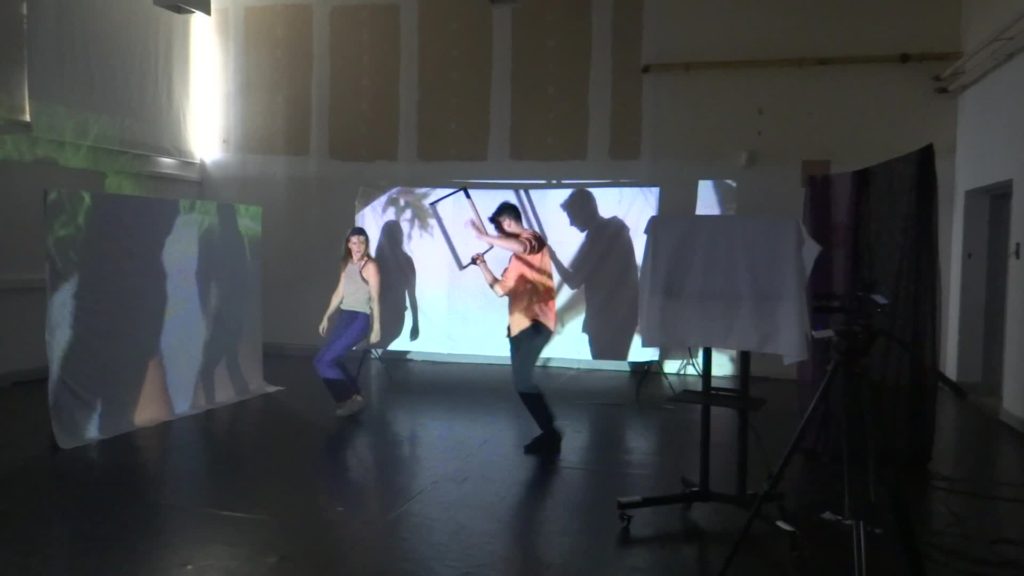
1/ Live “empty camera” dancing and somatic films projected and spilling over homemade screens, presented as a casual performance with live camera and monitor play.

2/ A more precise performance which relied on timing and scale, involving a projected duet and interactive live performance, using multiple layers of cloth acting as screens.

3/ An installation with live performance interactions, where images could be experienced in all directions of the space, on the front and back of translucent materials and mirrors and which invited the audience to move into and through the images.
Gaining responses from our audience about their experiences of the work was really useful and necessary – so much of our single-screen work isn’t shared whilst in development and therefore having audience feedback at the beginnings of new territory has definitely supported this research and the future of this work. We’re both excited about what’s next.